Ken Livingstone, former London Mayor, openly said that Tony Blair had ignored warnings from the security services in the early 2000s, about the possibility of terrorist attacks, following the UK's intervention in Iraq. In a dramatic debate on BBC One's "Question Time" programme last night, Mr Livingstone said when Mr Blair, as Prime Minister, had failed to take the threat of a terrorist attack on British soil into consideration.
Mr Livingstone declared on the programme that "If we had not invaded Iraq, those four men would not have gone out and killed 52 Londoners. We know that". Mr Livingstone's comments drew some applause from the audience, but fellow panellist Matt Forde. Forde, a former Blair-era political adviser turned comedian, was not pleased. He responded, branding Mr Livingstone's comments "shameful".
The Labour Party is facing an internal battle, over whether to support government proposals to launch strikes against ISIL in Syria. There has been much confusion over what course of action Labour MPs will be expected to take. Whispers of a possible "whipped vote" were swirling around, a matter of days ago. Under this scenario, Labour MPs would be instructed to vote in line with the party leader by the Whips, or risk deselection.
However, John McDonnell entered into the fray, saying he believed Labour MPs should have a free vote on the issue. Diane Abbott, Shadow Secretary of State for International Development, urged Labour MPs to go home for the weekend, and consider their decisions carefully. It is understood Labour MPs will return to work on Monday, and speak again on the matter, before the upcoming Parlimentary vote.
Things are beginning to get heated, with suggestions of resignations from the Shadow Cabinet, and some backbench MPs going as far as calling on Mr Corbyn to resign as Labour leader. To compound the headache for the party's leadership, there is a risk that a by-election in Oldham could hang in the balance, in a seat that Labour would have once considered a safe seat.
Saturday, 28 November 2015

Friday, 27 November 2015
Televised war of words over Russian jet
Russia and Turkey have been locked in a nasty war of words, days after a Russian Su-24 jet was shot down, on the Turkish-Syrian border. Both pilots survived the attack, but one was reportedly shot by Syrian rebels, as the pair attempted an emergency parachute landing. The other was safely rescued by Russian and Syrian forces.
A matter of hours after the attack, Russian President Vladimir Putin dubbed the attack "a stab in the back". Turkish President Erdogan has reportedly taken to Turkish television, to tell Russia not to "play with fire". President Erdogan also expressed his intention to speak to President Putin in person, when world leaders come together at a Paris-based climate change event, in a matter of days.
Turkey argued that the Su-24 jet had violated Turkish airspace, earlier this week, before it had been shot down. The area in question is a narrow strip of Turkish territory, that is surrounded by Syrian territory on three sides. The Turkish military claims it sent 10 separate warnings to the jet, in the space of 5 minutes. The first warning was reportedly received 17 seconds after the Turkish military had noticed the jet's alleged incursion onto Turkish airspace.
The surviving pilot insists no such warnings were issued, and is adamant that the jet remained in Syrian airspace, the whole time. As the repercussions of this event unfold, it is understood that Turkey and Russia have suspended strikes on ISIL in the area.
Mr Erdogan used his televised address to stress that he did not want Turkey to ruin its relationship with Russia. However, Russia has already made moves against Turkey, such as cancelling a visa-free travel agreement, which will be enforced from 1st January onwards. A rapprochement is far from certain, in this frosty climate.
A matter of hours after the attack, Russian President Vladimir Putin dubbed the attack "a stab in the back". Turkish President Erdogan has reportedly taken to Turkish television, to tell Russia not to "play with fire". President Erdogan also expressed his intention to speak to President Putin in person, when world leaders come together at a Paris-based climate change event, in a matter of days.
Turkey argued that the Su-24 jet had violated Turkish airspace, earlier this week, before it had been shot down. The area in question is a narrow strip of Turkish territory, that is surrounded by Syrian territory on three sides. The Turkish military claims it sent 10 separate warnings to the jet, in the space of 5 minutes. The first warning was reportedly received 17 seconds after the Turkish military had noticed the jet's alleged incursion onto Turkish airspace.
The surviving pilot insists no such warnings were issued, and is adamant that the jet remained in Syrian airspace, the whole time. As the repercussions of this event unfold, it is understood that Turkey and Russia have suspended strikes on ISIL in the area.
Mr Erdogan used his televised address to stress that he did not want Turkey to ruin its relationship with Russia. However, Russia has already made moves against Turkey, such as cancelling a visa-free travel agreement, which will be enforced from 1st January onwards. A rapprochement is far from certain, in this frosty climate.
Thursday, 26 November 2015
Autumn Statement
The Autumn spending review was unveiled in the Commons yesterday. This came after a post-election budget, all the way back in July.
Since George Osborne has been Chancellor of the Exchequer, all government budgets have been audited by the Office of Budget Responsibility.
In the pre-2010 era, governments pretty much made their budgets, relying on their own forecasts. This afforded Mr Osborne's successors a higher level of flexibility.
For the last 5yrs, it's been the OBR's job to ascertain whether budgets pass muster. They haven't been amazingly good at forecasting, it must be noted.
The OBR's first budget assessment/forecast ended up proving to be far too optimistic, in June 2010. In fact, it was overly optimistic for the subsequent March budgets, until the economy began to pick up in 2013.
Now we're told to expect GDP growth to average 2.4% in 2015-19. That's a tad below the UK's long term "trend rate" of about 2.8%. But it's enough to keep a lid on unemployment.
The fiscal story is interesting. Mr Osborne's detested tax credit cuts have been shelved, all £4.4bn of them. The police service has also avoided cuts. "How will he pay for it?" you might wonder.
Here enters Mr Osborne's saviour; his budgetary golden egg. He's expecting higher tax receipts. As wage growth continues to outpace inflation, it's assumed people will be in a better position to keep the coffers flowing nicely.
Of course, this all assumes a new recession or slowdown doesn't occur. In the "worst case scenario", we enter a new recession. If this happens, the government will fail to achieve a surplus by 2020, and blow their fiscal plans out of the water...again!
The central forecast, of mild growth, allows Mr Osborne to achieve this surplus. If growth accelerates, the deficit will vanish sooner.
Despite the scrapping of the cuts to tax credits, there are still concerns other measures will still hit households hard. The IFS estimates that other changes to benefits will hit 2.6m people, to the tune of about £1,600 a year.
Wednesday, 25 November 2015
Russian jet shooting - what we know
As has been the case, for the last couple of weeks, Russia has been launching an intensive bombing campaign in Syria, against ISIL. ISIL had openly boasted about blowing up a Russian airliner over the Sinai, 3 weeks ago.
Some are concerned whether the Russians are actually targeting ISIL, and not using it as an excuse to strike anti-Assad rebels. What is certain is that Syrian airspace is getting more and more crowded.
It's possible Britain will join the fray, and start bombing ISIL too, if a vote in Parliament next week goes the Prime Minister's way. As noted in a previous post, this would be an awkward moment for Jeremy Corbyn.
Yesterday, it started being reported that Turkish forces had shot down a Russian Su-24 fighter jet. The two pilots reportedly ejected, and attempted to parachute to safety.
Footage was taken of the jet crashing, as well as shots of the pilots parachuting to safety. One of the pilots was allegedly shot, before he could reach safety, during this dangerous descent. The other pilot is reportedly safe and sound, on a Syrian airbase.
Tuesday, 24 November 2015
The Sun does it again
.jpg/1280px-'The_Sun'_bus_(9661587335).jpg)
Another week, another scandalous story from Murdoch juggernaut, The Sun newspaper.
The other week, it was "guess who has HIV?".
This week, the Sun insists that 20% of British Muslims are sympathetic to jihadists somehow.
It wasn't long, though, before more enlightened publications pointed out major holes in the Sun's story.
To make matters worse, the polling company the Sun quoted for the story has distanced itself from the Sun's claims.
So what did the Sun actually claim?
The Sun claimed 1 in 5 British Muslims supported supported jihadists, in its big bold headline.
Except the poll didn't ask about jihadists. It asked about how respondents felt about people travelling off to Syria to fight. It didn't ask WHO these people were fighting for.
The Independent newspaper rightly noted that some British people who've gone to fight in Syria have actually gone and joined the Kurds, who are opposed to the likes of ISIL.
The same Indy article also identifies a problem common in these kinds of polls. If you use the word "sympathy" as part of a question, you ought to expect some kind of emotive response, whatever the question.
One final note: in the same kind of questioning, 14% of Britidh non-Muslims agreed that they were "sympathetic" to those heading off to fight in Syria. Does that mean they love ISIL too? Of course not.
But the Sun newspaper doesn't care. The story is out there now. All we can do, when the Sun publishes this kind of dishonest information is to fact check it, and publically call the Sun out.
It won't halt their sloppy reporting, but at least it might make a Sun reader pause now and then, and consider their reading habits from now on.
Momentum - Important points
 |
| Momentum - the movement dedicated to preserving the power of Corbynmania |
This summer's Labour leadership election was one of the most dramatic events of the political year. Although the Labour Party went into the 2015 election, and ended up with its worst ballot box result since the 1990s, there was a refreshing feeling about the process to choose Labour's new leader.
Momentum is a product of this battle of ideas, which culminated in Islington MP Jeremy Corbyn winning outright, by amost 60%, back in September. It's an organisation, that evolved from the campaign to get him elected leader. Today, let's take a closer look at the shiny new group, supporting Labour's newest leader.
1.) Momentum serves to entrench Jeremy Corbyn's popularity
 |
| Momentum propelled Corbyn into his job - and they won't the party forget it |
2.) Momentum returns back to Labour's grassroots - but some MPs are concerned
 |
| Labour Party Membership (1928-2015) Note the Corbyn spike this year |
The straight-to-grassroots approach essentially circumvents the sitting Labour MPs (otherwise known as the Parliamentary Labour Party or PLP). Momentum believes the PLP no longer reflects the Labour Party. Members of the PLP fear that Momentum is not working in the interests of the party as a whole.
3.) The next few days will let us see what Momentum is made of
The Prime Minister is expected to call a vote on bombing ISIL in Syria, in Parliament next week. Momentum's Twitter page has told Labour voters to lobby Labour MPs to vote in line with Jeremy Corbyn.
Whatever happens after the vote will demonstrate how strong or weak the Momentum group actually is. Is it some political Charybdis, capable of engulfing all its naysayers, or will the PLP risk it? Will the PLP have the last laugh, by voting overwhelmingly in favour of strikes?
4.) Momentum will matter as Mr Corbyn needs help - Labour's polling performance has been far from stellar since Mr Corbyn's victory
 |
| Courtesy of ComRes |
If Mr Corbyn is going to make the gargantuan leap from Labour leader to future Prime Minister, he has to not only win over his party faithful; he needs to make the country fall for Corbynmania too. Otherwise, Labour will face a drubbing worse than the party's 1983 nadir, under leader Michael Foot.
The latest ComRes poll indicates Labour has dropped to 27%, its worst showing since Labour's traumatic ousting in May 2010. The Tories remain stable at 42%, and the limping Lib Dems are stagnating, at a measly 7%. It's starting to look like Mr Farron's first few months as Lib Dem leader has failed to produce a sizable bump in the polls.
5.) If Momentum grows in strength, Labour may fracture
There is a genuine possibility that Labour could split again, if relations with the PLP grow increasingly sour. Momentum might argue it represents the true socialist elements of the Labour Party, and that the PLP is an out-of-touch centrist blob.
The PLP would insist that it represents a more progressive, modern-thinking part of the Labour movement. It is unlikely there'll be an actual split though. If the Lib Dems languish under 10% for the time being, dissatisfied PLP members would probably rather grin and bear a few years under Mr Corbyn, than attempt to create a new social democrat party.
Monday, 23 November 2015
George Osborne's budgetary dilemma
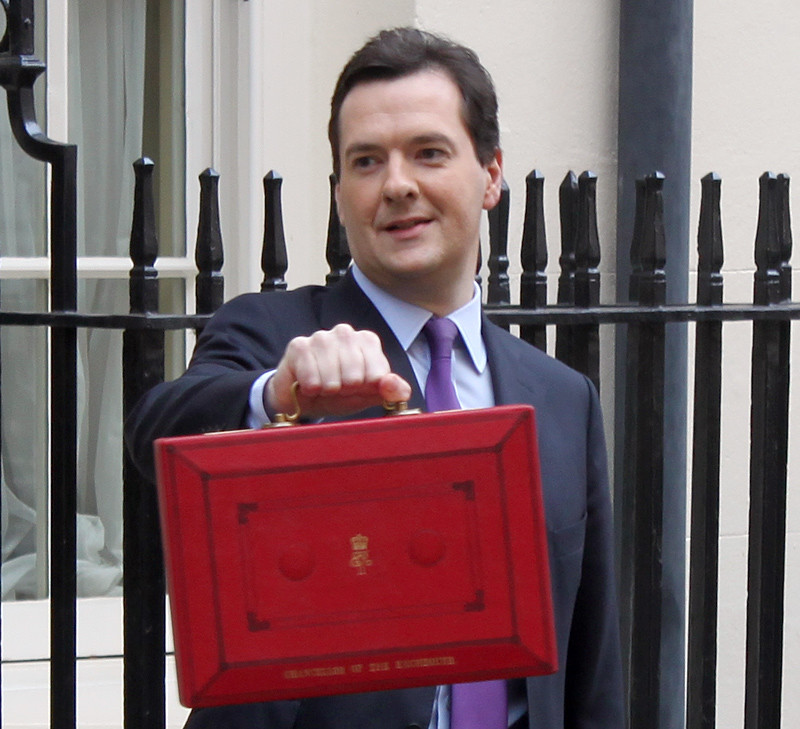
On Wednesday, Chancellor George Osborne is set to address Parliament with his autumn spending review. It's all a bit grim, behind closed doors.
The government's bruising defeat in the House of Lords, over tax credit cuts in late October runs deep. The Chancellor vowed to make £4.3bn of cuts to tax credits, but given the defeat, the Chancellor may have to look elsewhere, for fresh pickings.
At present, the UK government has a budget deficit of roughly £83bn, in the year to October 2015. The Coalition came to power in 2010, vowing to eradicate the deficit entirely by the 2015 election.
The persistently high deficit is a consequence of weak tax receipts, owing to slower-than-expected economic growth in 2010-15. It's also due to an effective "pause" in austerity, that took place briefly in 2012.
National debt is still climbing, rising past £1.6trn in recent months, the ONS suggests.
To make up for failing to eliminate the deficit, the new Tory majority government pledged to eradicate the deficit (again), by the next election, in 2020, and achieve the golden target; a budget surplus of about £10bn.
They also pledged to make it law that future governments must run a budget surplus, unless the economy slows down too much.
The Paris attacks, and Brussels remaining in lockdown, for fear of a possible attack put pressure on the Chancellor to avoid cutting the police service, which, along with other departments, could face cuts of up to 30%.
The Chancellor's problems are all compounded by another issue: according to the ONS, borrowing in October 2015 was actually worse than expected. All of these issues have combined to leave a nasty taste in the government's mouth.
Subscribe to:
Posts (Atom)