Tuesday, 3 May 2016

Countdown to Mayoral Election 2016

Labour Mayoral candidate Sadiq Khan remains firmly in the lead, against Conservative rival Zac Goldsmith, two days before election day, says poll.


Photo by Peter Adams


It was supposed to be easy. When Zac Goldsmith became the Conservative candidate for London Mayor in October 2015, he was probably hoping some of his predecessor's supposed golden touch would rub off on him.

Mr Goldsmith's Mayoral campaign is now stuck with the moniker "dog-whistle politics", following statements about Mr Khan, such as the fact that he was allegedly "playing the race card".

The campaign received fresh criticism following the printing of a Zac Goldsmith-penned article in the Mail on Sunday. The headline read:

"On Thursday, are we really going to hand the world's greatest city to a Labour Party that thinks terrorists are its friends?".

The article carried an image of the wreckage of the Tavistock Square bus, which was one of the targets of the 7/7 Attacks in July 2005. As a sign of how poorly perceived the article was, ex-Conservative Party Chair Sayeeda Warsi took to Twitter to say:


Source: @SayeedaWarsi (Twitter)


Two days before election day, Mr Goldsmith remains 9 points behind Sadiq Khan in first preferences, a new Opinium poll suggests. In the second round, where the two would go head-to-head, Mr Khan's lead extends to 14 points over Mr Goldsmith.

The race is, on the face of it, a two-horse race. The remaining candidates are somewhat obscure, some might say. Here's a look at the field of other party candidates.

Caroline Pidgeon, Liberal Democrat candidate

The Liberal Democrat candidate Caroline Pidgeon remains confident that her campaign will make progress, despite the fact that she remain stuck at an average poll share of about 5% of respondents. Early in the year, her press team emailed Left Handed Dude to say that her campaign was:

"getting a very positive response...People are keen to hear about my plans, particularly my ideas about how to deliver the extra homes London needs, a fairer fares regime on TfL's Tube and rail services and how we tackle the cost of childcare in the capital".

Sian Berry, Green Party Candidate

Green candidate Sian Berry is marking her second attempt to become Mayor, after her 2008 bid. Her campaign has made effective use of billboards, one of which is on display near Ealing Common Tube Station, albeit tucked away from the high street somewhat. Her poll rating is roughly 4% at present.

In an election campaign film, Berry rattles off her party's list of proposals, as she walks through the streets of the city. Berry highlights how the Generation Rent group has rated her campaign highly, for proposing a renters' union to stick up for private renters, in order to tackle the issue of soaring rents in the capital.

Peter Whittle, UKIP Candidate

Openly gay UKIP candidate Mr Whittle shares Mr Goldsmith's support for a Brexit on 23rd June, and he has tried to diversify his party's message in the capital. He made waves in back in February, when he claimed "white, middle-class liberals" are the "most hostile, close-minded group", but his poll ratings remain stuck at much the same level as the Greens and Lib Dems, at about 5%. He has focused on social housing, making the following pledge:

" I would give priority to Londoners on social housing if you have lived in a London bourough for 5 years".

George Galloway, Respect Party Candidate

Perhaps one of the more controversial candidates, ex-MP George Galloway has been campaigning to become London's first Respect Party Mayor. However, his campaign has failed to make much of an impact since he announced his intention to run, in May 2015. His poll ratings have failed to budge over 2% consistently. 

In a move which indicates his candidacy is more of a stepping stone towards other projects, Mr Galloway has claimed he will try to run as the Respect candidate in Tooting, if a by-electon is called, in the event of Mr Khan winning the Mayoralty.

The Respect brand is struggling at present. Its membership base is estimated at just over 600 members as of 2014, and it was alleged that one-time Respect leader Salma Yaqoob made a failed attempt to join the Labour Party last year. To compound the sense of discontent, the Spectator claimed Respect had assets totalling under just £2k. When considering Respect, it's perhaps best to view it as a personal vehicle for George Galloway, as opposed to a fully fledged party.

Mr Galloway tweeted the following message as part of his online campaign in February:

"Elect a leader that will fight for all not just those dripping in GOLD".

The tweet drew ridicule from a small group of tweeters, including user Marc Blanc, who wondered: "Is 'dripping in gold' a euphemism for something now? I didn't attend the meeting".

Writer Jeremy Duns teased the tweet later that day, saying: "Rappers have rights, too, George".

Ignoring the polls, what ever the final results are, the 2016 Mayoral election will have a serious impact on the current political environment. A Labour victory will be used by Corbyn allies to show support for the party's new direction is vindicated. Moderates might argue however that Mr Khan might win in spite of Mr Corbyn, not thanks to him. Failure to win will be a blow to Mr Goldsmith and the Conservatives, bringing an end to major election victories over Labour since 2008.

If Mr Goldsmith wins, the Eurosceptic wing of the Conservative Party will feel emboldened, and will compound the sense of victory for the party as a whole, if the government makes gains in local elections throughout the country. Losing to Mr Goldsmith will be seen as a huge blow to confidence in Jeremy Corbyn's position, some might say. If Labour can't get back the Mayoralty, it might be a sign of the party being poorly placed to regain Number 10 in 2020.

Two days to go till voting day itself. If you plan to vote in the London Mayoral election, remember to place your preferences on the lilac ballot paper, and rank your favoured candidates in order of preference. Remember to check the orange ballot paper, to help elect members to the London Assembly.

At present, Labour holds 12 seats on the Assembly, with the Conservatives on 9 seats, plus the Lib Dems and Greens both holding 2 seats respectively.

Sunday, 24 April 2016

Brexiters bash POTUS

It was supposed to be a short and fairly chummy visit by President Obama, at the end of this week. His UK trip managed to coincide with the Queen's 90th birthday, and it became clear he would use the visit to reiterate his pro-EU views.

Mr Obama's visit was accompanied by an article he authored, published in the Telegraph, addressing readers in the following way:

"As your friend, let me say that the EU makes Britain even greater".

Then Boris put pen to paper.

Boris Johnson used a column in the Sun newspaper, to try and claim that Mr Obama had shown proven anti-British sentiments since his first day as POTUS, by removing a bust of Winston Churchill from the Oval Office, and reportedly having it sent to the British Embassy in Washington.

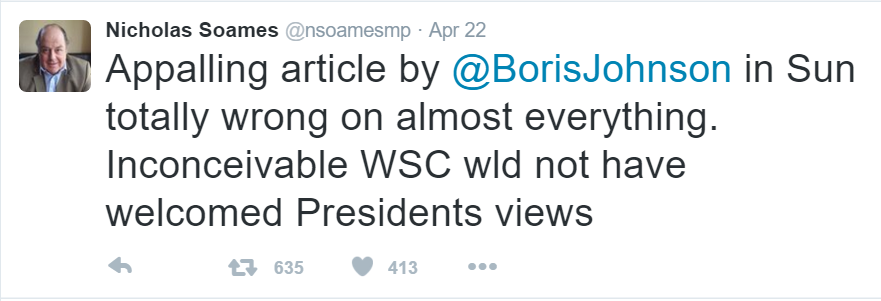
His comments quickly attracted ridicule. Mr Churchill's own grandson, sitting MP Nicholas Soames poured criticism on Mr Johnson's comments, saying:


When the descendants of historical figures you've chosen to invoke start debunking your arguments, you know you're having a bad day.

Mr Johnson's comments largely drew criticism over him choosing to mention Mr Obama's part-Kenyan heritage, as part of his column. It echoes the sentiments that flared up in 2011, when Donald Trump demanded that Mr Obama release his birth certificate. Mr Obama found them, and as expected, they proved he was born in Hawaii afterall. He later roasted Mr Trump at the April 2011 Correspondents Dinner.

The fact that people keep bringing up the Kenyan connection is troubling; it comes down to an inability to provide a logical argument to whatever Mr Obama is championing. Instead of creating a rational opposing argument, Mr Johnson and Mr Trump have resorted to making ancestry the issue.

Some might simply call this an example of dog-whistle politics. It's been seen to an extent with the 2016 London Mayoral Campaign. Sadiq Khan was accused by rival Zac Goldsmith of "giving cover to extremists".

You could say this outburst by Mr Johnson is some kind of bonkers siren call to Britain's closet xenophobes. Maybe Mr Johnson is testing the waters, to see just how far he's allowed to go. Or he might just genuinely think the Kenyan thing actually matters.

Such a move might have backfired on the Brexit campaign however. Mr Obama enjoyed very high approval ratings amongst a sample of Brits polled by the Pew Research Centre in 2015. 76% of UK respondents had a lot of confidence that Mr Obama was "doing the right thing regarding world affairs".

In comparison, his predecessor, George W Bush was only about half as well-received across the pond. Here in the UK during the Bush Junior years, about only half of respondents thought he was doing the right thing. How times have changed.

Having the mascot for the Brexit campaign openly bashing a US President that Brits actually quite like is just the latest controversy in a campaign that's still got another 7 weeks left to go.

Monday, 4 April 2016

Panama Papers leak

Members of the global elite are in spasms of panic, following the leak of millions of documents, from Panamanian law firm Mossack Fonseca.


Photo by Christian Taube / CC BY


Reports began to trickle in on social media, at about 10pm GMT about the leak. German publication Süddeutsche Zeitung has been credited with receiving the documents, which were eventually passed onto the International Consortium of Investigative Journalists (ICIJ).

It is estimated they acquired about 11.5m documents, dating back to the 1970s, which go into great detail about years worth of transactions by wealthy individuals, using about 214k offshore companies in the process, it is alleged.

It is a sensitive revelation for global elites, because some of those involved currently hold high office, in some cases reportedly.

The scale of the leak is unprecedented. It dwarfs the Wikileaks Cablegate leak of 2010, with emails, photos, PDFs and a range of other files all adding up to 2.6 Terabytes.

To put this into perspective, you would supposedly require 40 Blu-Ray disks, just to store 1TB worth of data.

VIPs linked to the Panama Papers


Of significance to UK readers, David Cameron's late father has been reportedly mentioned.

Much focus, however, has been given to transactions relating to the President of Argentina, Mauricio Macri, as well as documents reportedly pertaining to associates close to Russian President Vladimir Putin.

RT (formerly Russia Today) predictably reacted to the news, by claiming the media were giving excessive coverage to the documents which implicated those close to President Putin.

This is yet another demonstration of the outlet's bias, given that RT omitted actually including details about said documents. The bulk of this article decided to focus on a series of tweets about the coverage instead of the leak itself.

There is also mention of documents, reportedly relating to Ukrainian President Petro Poroshenko. Ukrainian NGO/exclusively online news outlet Hromadkse.TV showed some enthusiasm in publishing information about his alleged involvement in the matter.

One of their English-language reporters, Ian Bateson tweeted the following, which serves as an effective contrast between the ways people chose to cover the story:


Source: @IanBateson (Twitter)


The offshore companies mentioned in the leaked documents will be fully published in early May, according to the ICIJ.

Friday, 1 April 2016

US economy roars ahead, with record job creation

The US jobs market continues to enjoy a sunny spell, with 215k jobs created in the month of March.


Obama took office at the depths of the recession. 6yrs of jobs growth has followed.
Source: St Louis Fred


Today's job report in the US marks the longest continuous period of jobs growth since 1939. 2.8m jobs have been created in the last 12 months alone.

After the dog days of the Bush Junior Presidency, where the economy endured 2 recessions and the US saw next to no jobs growth, the Obama Presidency has seen a steady recovery to new all time highs in employment.

The jobless rate ticked up to 5%, and some might say it's a sign that the good times are over. It's a puzzling paradox, you might think. Lots of new jobs, but more people out of work; what?!

Simple explanation: The job creation stat shows businesses are still happy to hire. The rise in unemployment, therefore, is a result of an increase in people entering the workforce, trying to find work. Possibly a sign of improving confidence.

Back in 2008, the collapse of Lehman Brothers sent shockwaves around the world. US unemployment hit about 10%, a level not seen since the mid 1980s. It was essentially viewed as a crisis level of joblessness.

The Obama recovery


Mr Obama's era in the White House has come to be associated with a steady recovery, albeit slightly weaker than hoped. Economic growth has taken a hit. Its pre-crisis average was 3% growth, but since 2010, it has dropped to 2% or so.

This recovery was mainly possible, thanks to a quick dose of fiscal stimulus, to bail out the car manufacturing sector, as well as the financial sector (apart from Lehman Brothers of course).

7 years of low interest rates coupled with quantitative easing aided this move, and in conjunction, they have slowly dragged the US out of a downturn which some feared could spiral into a new great depression.

The stimulus ended in 2010, as recession turned to recovery, and the mounting debts in industrialised economies began to become a burden. The period of low rates has just come to an end in the US, as we saw in December.

However, Fed Chair Janet Yellen soothed markets the other day, saying rate rises in 2016 would be less frequent than previously forecast. It's all just a question of how long it takes for inflation to take off again, before rates will need to continue their inevitable rise.

Greenback claws back losses of past decade


One of the disappointments about the Obama recovery is the lack of strong wage growth. The average American household has seen their income stagnate since the start of the new millennium.


The fall in real incomes explains the dissatisfaction with the recovery
Source: St Louis Fred


However, one of the quirks of the Obama years is the recovery in the USD's value. Between 2002 and 2008, it was falling, just as commodities like Oil and Gold soared.

The recovery in the US has prompted an end to monetary easing, causing the Dollar to rally. Commodities priced in Dollars have subsequently fallen, causing difficulties in countries that rely on exporting these materials.

A consequence of a stronger Dollar is lower-than-expected inflation. The Fed has now got a 2%-target for inflation, so they'll most likely keep eyes peeled on that, plus wages, before hiking any further.

US GDP figures for the first 3 months of 2016 are expected at the end of April. Some have feared growth may be seen to have slowed down, owing to jitters earlier in the year.

Thursday, 31 March 2016

UK Steel crisis rumbles on, with 40k jobs on the line

Indian steel giant Tata's plans to sell off its British assets has sent shock waves through an already-turbulent British Steel industry.


A staggering 40k jobs could be lost, if no one is willing to buy Tata's assets. To put this into perspective, imagine Wembley Stadium being at full capacity, and then someone telling about half the crowd that they're being laid off.

If private investors refuse to buy the assets, there's always the chance that the government could step in, and perform an interventionist manoeuvre, otherwise known as nationalisation.

However, when asked about the Steel crisis, the Prime Minister told Sky News earlier today: "I don't believe nationalisation is the right answer".

Readers might recall how the government bailed out and nationalised a handful of British banks, including RBS and HBOS. It's an easy comparison to make, surely?

Twitter user Primly Stable added some perspective to the nationalisation debate, after some users tried to compare the steel industry to the banking sector, during the 2008 crisis.


Source: @PrimlyStable (Twitter)


Labour leader Jeremy Corbyn strongly urges that Parliament be re-called, to debate the issue, given the number of peoples' careers being at stake.

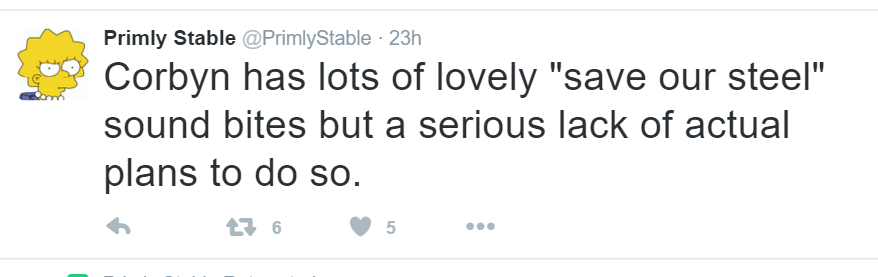
Primly Stable added some further commentary on Jeremy Corbyn's position.


Source: @PrimlyStable (Twitter)


An e-petition for Parliament to be re-called has rapidly gained traction. Late last night, it had only attracted about 7k signatures, but this has since swollen to well over the 100k level (116.5k as of Thursday 31st March). 

Now this number of signatures has been reached, MPs are compelled to debate the issue, at a forthcoming session in the House of Commons.

It's a slightly confusing strategy; MPs, owing to sheer public pressure, will probably want to raise the issue regardless. 

Organising for a debate about re-calling Parliament, to talk about the steel crisis, when MPs will be doing it anyway makes the whole thing seem well-intentioned but some might say it's a little bit pointless. Debating is a pretty vital part of an MP's job.

Fraying nerves of Steel


Signs of trouble for British Steel were already apparent back in late 2015, when Chinese President Xi Jinping visited the UK. The visit was made awkward, when some started to accuse China of dumping massive amounts of Steel into European markets.

As any economics professor will tell you, when the quantity of a commodity (e.g. Crude Oil) increases, the overall value of the commodity (e.g. each barrel of Oil) diminishes. The same applies for steel.

As China's industrial boom starts to slow, and the economy rebalances towards domestic consumption, the glut in industrial materials it produces are starting to find new homes on stranger shores.

As shown below, the value of a metic ton of steel has been see-sawing, since the global financial crisis. It's been especially downbeat since it peaked in 2015, at 500 USD per MT. It has since tumbled all the way down to just 90 USD per MT.


It's even worse, when you consider that Steel prices were at a lofty 1265 USD per MT back in 2008. This crash in commodity prices in general is, in large part, responsible for the wave of deflation we've seen, particularly in Western economies.

Tuesday, 29 March 2016

Vote Leave's dossier of EU's 50 dodgiest people (EU Referendum latest)


Photo by Danny Howard (Flickr) / CC BY


Project Fear moves in mysterious ways. Sometimes, it's dubbed a tactic of the Vote Stay campaign. Now it seems to have switched sides for a change.

Vote Leave decided to publish a dossier today, detailing 50 EU nationals with a criminal history, who were able to enter the UK, thanks to the EU's free movement principle.

One of the criminals listed is Arnis Zalkalns, the man suspected of having murdered Ealing schoolgirl Alice Gross, back in late 2014. Alice was last seen, walking by a West London canal, during the summer holidays. Her body was later found, hidden in the canal.

Zalkalns vanished for a time, but was declared dead, after remains were eventually found in a park, and his death was treated as a suspected suicide.

Vote Leave's controversial move has prompted some ridicule from its critics. Comedian David Schneider took to Twitter, to summarise the bafflement many felt with the dossier.


This is just the latest tactic, as part of the Brexit campaign's version of Project Fear. It's official; the campaign is stuck in negative point-scoring mode now.

A slew of polls since mid-March has indicated that the public are narrowly verging towards supporting continued EU membership, according to Ipsos Mori, ICM, ComRes and YouGov.

This sort of outcome would be probably the most awkward one for the Prime Minister. The Pro-In/Brexit factions within the Conservative Party is already starting to lose patience with one another.

There is a tangible sense that the Prime Minister's position is threatened, whatever the outcome of the referendum, whether it comes in the form of his obvious opponents, across from the dispatch box, or amongst his own party's rebellious backbenchers.

If a Brexit just pips it to the top and takes place, Mr Cameron will likely face calls to resign, particularly from the opposition, for being the Prime Minister who took us out of the EU. 

In this scenario, the Conservative Party's Brexit wing, lapping up the victory, would demand a more representative face in charge.

On the occasion of a narrow win for staying in, Brexit Conservatives will feel humiliated and lash out at the Prime Minister for not supporting their side. 

However wide or narrow the margin, a loss for the Brexiters would be a monumental blow; a decisive failure to win what's been a generation-long battle for supremacy.

Tuesday, 22 March 2016

Fallout from Budget 2016: Omnishambles 2.0?

History has repeated itself for the beleaguered Chancellor this spring. 2012 marked a low point in the coalition government's fortunes, but a new looming threat is approaching, post-haste.


Photo by Lies Thru a Lens / CC BY


In a move that pundits were quick to call the "IDS of March" (scraping the barrel, I know), the Cabinet lost its Secretary for Work and Pensions, Iain Duncan Smith, after 6yrs in the job.

Proposed cuts to disability benefits were eventually scrapped, but the muddle following last Wednesday's Budget prompted ex-Conservative leader IDS to reconsider his role, it's understood.

To avid EU referendum watchers, IDS is one of the most prominent Eurosceptics in the Conservative Party, and so his resignation is undoubtedly being viewed through this lens.

IDS did the rounds of several televised interviews over the weekend, following his decision. The Mail on Sunday reported that Mr Cameron allegedly "exploded with rage" at IDS's news, and it was also alleged he called him "dishonourable", but it remains unclear how this information was ascertained.

In an interview on the Andrew Marr Show, IDS took a swipe at the now-scrapped proposals, branding them "deeply unfair", as well as accusing the government of moving to please Tory-supporters of pensionable age or over, at the expense of the poorest in society.

IDS also insisted his decision was unrelated to the upcoming EU referendum, but his charged language implies some kind of crafty game-plan to potentially shape public opinion, in an atmosphere where the slightest spark could ignite sufficient support for either side of the campaign.

The resignation is perhaps the first outburst of dissent, in a governing party that is on the brink of a major skirmish. The Conservative Party was left scarred in the early 1990s, over the Maastricht Treaty, and suffered something akin to a "lost decade" in the wilderness, before recovering in the run up to the 2010 election.

Just as the Scottish referendum has not healed wounds over the desire for some in Scotland to move towards a more independent nation, the EU referendum is unlikely to heal the Conservative Party's schism. In fact, it might trigger a new leadership election, if reports are to be believed.

The Sunday Times spoke to an un-named minister, who claimed the Prime Minister "wants to fix the problem. He wants to get rid of the t***s who have caused all the problems. There will be a reckoning.”

Only 50 MPs are required to call for a leadership race, and there is a possibility a Brexit candidate might challenge Mr Cameron, and even dismount him, before his second and final term is over. In the run-up to the 2015 election, Mr Cameron had told James Landale from the BBC that "Two are wonderful, three might just be too many".